

Galaxy Note 10 Plus Video Stabilization
Please note: In Oct 2020, nosotros updated the DXOMARK Camera test protocol. Version 4 now includes image preview tests and a wide range of new test scenes every bit function of our new trustability evaluation which measures the camera's ability to deliver consistent still image and video quality across all shooting scenarios. We have retested this device using the new version iv of the test protocol and produced this completely updated review. For more data, please see our commodity about preview, trustability and other version 4 updates of the DXOMARK Camera examination protocol.
The Samsung Galaxy Note10+ 5G is the Southward Korean manufacturer'due south previous flagship "phablet," at present replaced by the Note20 series. Originally launched in August 2019, the Note10+ 5G features a large 6.8-inch AMOLED display with 1440 x 3040 (495 ppi) resolution, and is powered past the Exynos 9825 chipset with a whopping 12 GB of RAM. The photographic camera setup offers no fewer than four sensors, including a standard 26 mm primary camera, a 13 mm ultra-broad photographic camera, a 52 mm tele-lens, and a defended time of flight (ToF) sensor for depth interpretation in portrait mode. The main camera uses a 12 MP sensor with ane.4µm pixels coupled to a variable-discontinuity f/1.5-ii.4 lens with dual-pixel autofocus and optical paradigm stabilization (OIS). The ultra-broad-angle boasts a higher-resolution 16 MP sensor with 1.0µm pixels and a stock-still-aperture f/2.two lens. The tele-camera comes with a 12 MP-resolution sensor and a slightly brighter f/ii.1-aperture lens. The device too captures 4K video at thirty fps in default mode, with 60 fps bachelor.
Read on to find out how the Samsung Galaxy Note10+ 5G performed nether the brand-new version 4 of the DXOMARK Camera test protocol.
Update summary
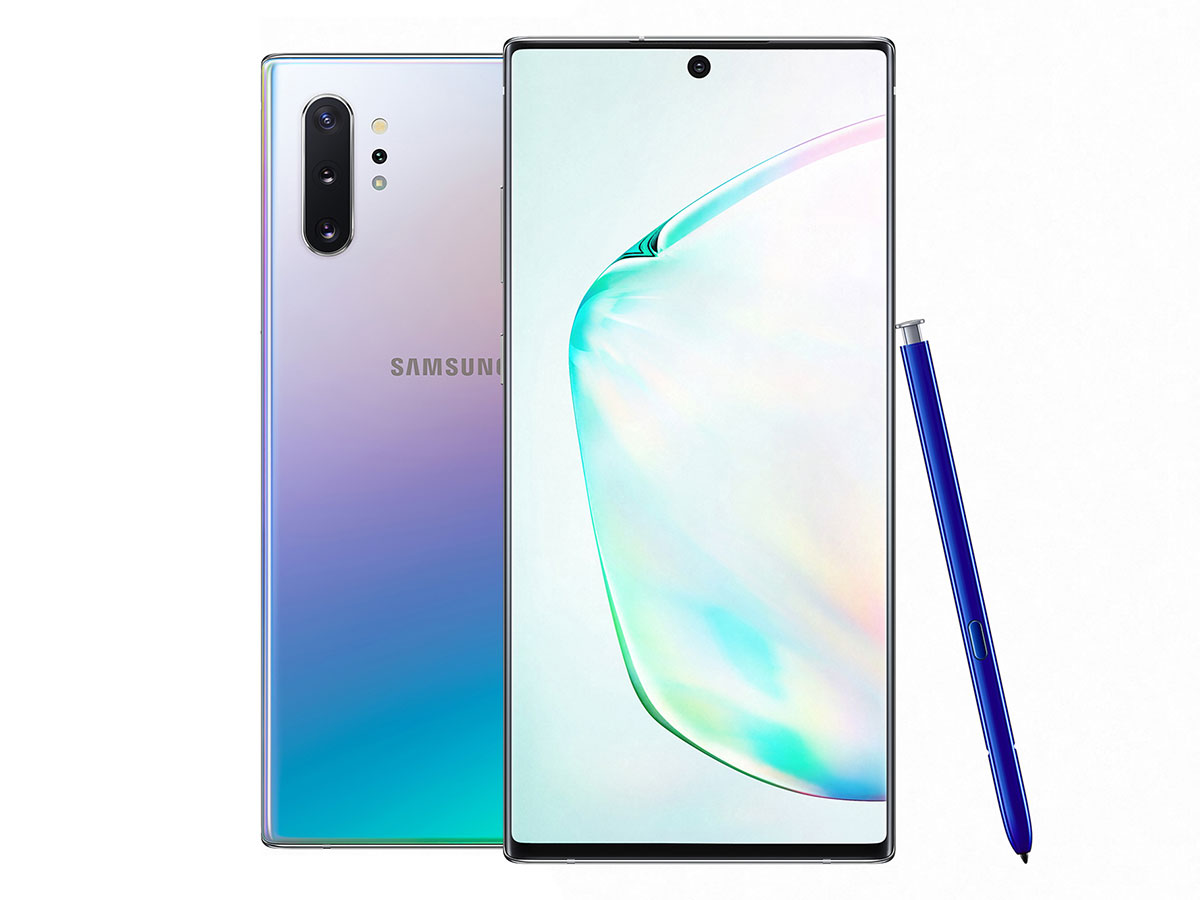
Samsung Galaxy Note10+ 5G

116

camera
91
Best: Honour Magic4 Ultimate (111)
93
Best: Apple iPhone 13 Pro Max (107)
89
All-time: Asus Smartphone for Snapdragon Insiders (109)
83
Best: Xiaomi Mi eleven (111)
69
Best: Honor Magic4 Ultimate (102)
63
All-time: Google Pixel 6 (77)
50
Best: Huawei Mate twoscore Pro+ (82)
75
Best: Huawei P50 Pro (lxxx)
51
Best: Apple iPhone 13 Pro Max (80)
84
Best: Honor Magic4 Ultimate (140)
42
All-time: Award Magic4 Ultimate (58)
89
Best: Apple iPhone 13 Pro Max (118)
101
Best: Honour Magic4 Ultimate (107)
93
Best: Apple tree iPhone 13 Pro Max (109)
73
All-time: Oppo Reno6 Pro 5G (Snapdragon) (99)
89
Best: Apple iPhone 13 Pro Max (105)
80
Best: Oppo Find X2 Pro (94)
86
Best: Vivo X70 Pro+ (103)
An updated DXOMARK Camera overall score of 116 for the Milky way Note10+ 5G puts Samsung's 2019 phablet device just behind the leading pack of 2020 flagships in our latest scoring system. Broadly speaking that ranking holds truthful beyond our 3 sub scores, where the Note10+ 5G achieves a Photograph score of 118, Zoom score of 67 and Video score of 105. There are a couple of notable exceptions for its performance in private categories however. For example, the Notation x+ 5G secures splendid scores for bokeh and ultra-wide shots – where it can go toe to toe with the latest 2020 devices – and offers cracking video color, likewise. On the flip side, its video stabilization score is low compared to many devices we've retested.

Good target exposure and nice color, although with a slightly cold white balance cast
Previously a summit-ranked device in our database, the Samsung Galaxy Note10+ 5G is still a very solid performer for stills. The principal camera does a dandy job with the basics, delivering accurate target exposures and broad dynamic range in both outdoor and indoor images. Colors are vivid and pleasant in most conditions, although occasional white balance errors are visible, including a blueish color bandage in cloudy outdoor conditions. The texture-versus-noise tradeoff is fairly well controlled, too, and so in general you can expect good item and low noise. That said, at that place are a couple of specific bug our testers noted, including occasional unnatural rendering of fine textures, as well as slightly visible luminance racket in dark areas in indoor and outdoor shots. Depth of field is slightly limited, possibly equally a upshot of the variable-aperture lens on the master camera, just the Note10+ 5G includes an effective flash module capable of delivering loftier detail on portraits shot in depression light.
Some depth estimation errors occur when shooting in portrait mode, with edge artifacts visible effectually the subject, just the depth-of-field effect is pleasant, with images displaying a realistic blur slope and well-contrasted bokeh spotlights. The tele-camera is also very expert at close and medium range, with these zoom shots displaying a good detail, but there'southward a noticeable loss of resolution in the Note10+ 5G's long-range zoom shots.

Nice texture versus noise trade off in depression light, merely luminance noise is visible in nighttime areas and a orange color cast is visible.
The Note10+ 5G is besides a very capable device for capturing video. Tested at its 4K/30 fps setting (which offers the best results), the texture-to-racket ratio is fairly high in outdoor and indoor weather condition, where you can exist confident of good detail with relatively depression levels of visual noise. It's slightly less successful in depression calorie-free, however, where strong and fibroid dissonance can be a lilliputian distracting. Our analysis of video color rendering is similar, with the Note 10+ 5G delivering bright and well-saturated colour in outdoor and indoor videos, merely it suffers a bit in low light, with color casts often visible under low artificial lighting.
Video autofocus is fast, with practiced tracking capabilities, as well as generally stable performance that avoids any significant overshoots or hunting. The stabilization system isn't quite as constructive, however. While users won't take besides many complaints about handheld static videos, if you lot're capturing movies while walking, expect to see some residual move effects on playback. A couple of visible artifacts, including color quantization and ringing, resulted in a small signal deduction in the Note 10+ 5G's video score, but on the whole the device is a solid performer when capturing moving images.
Samsung Galaxy Note10+ 5G, outdoor video
Samsung Galaxy Note10+ 5G, indoor video
Preview
With noticeable variations in prototype quality between preview and capture in both standard and bokeh shots, the Note10+ 5G isn't 1 of top-ranked devices in this category. Shooting in loftier-contrast weather condition, dynamic range in preview is limited, with overexposed highlights, and target exposure on faces is often quite dark in low light. You lot can see in the HDR example below that captured images display more particular in the sky and slightly ameliorate target exposure on the face compared to the preview image.
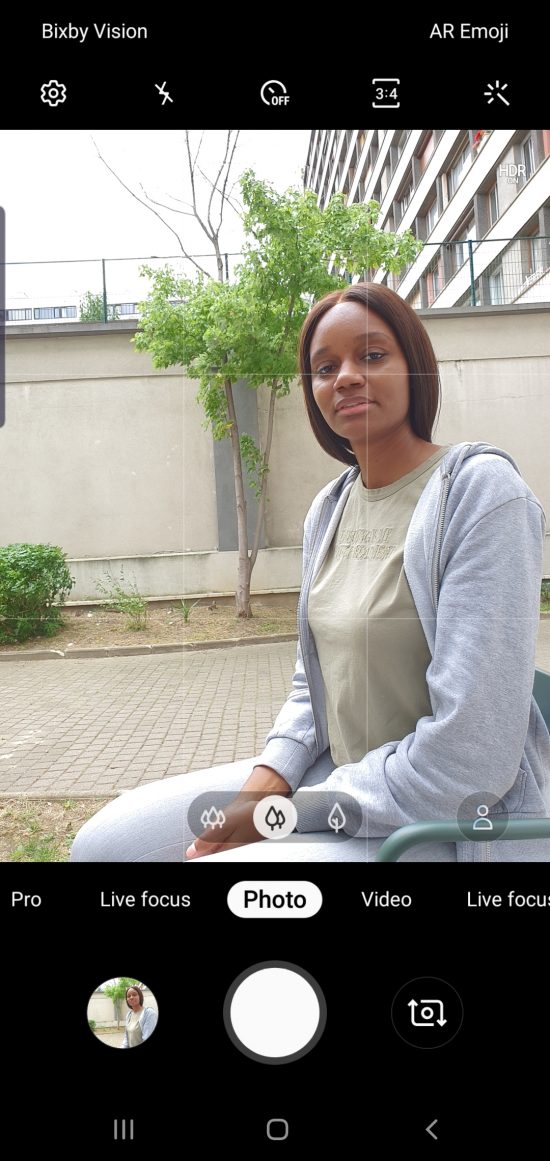
Preview: limited dynamic range overexposes the highlights and underexposes the face.

Capture: both exposure and colour are unlike in the final epitome.
In portrait fashion, bokeh simulation isn't e'er activated in preview, and our testers observed some failures, notably under indoor lighting conditions. The device does provide an on-screen "effect-gear up" confirmation for reassurance that the effect will be applied and a face has been detected. Although this is a useful characteristic, information technology doesn't bear on the score in our assay. The depth-of-field event displayed is besides a good likeness, with blur intensity and gradient comparable to the final capture. On the downside, depth estimation isn't convincing, as edges of the portrait are often blurred, leaving some room for improvement for Samsung engineers in terms of this feature.
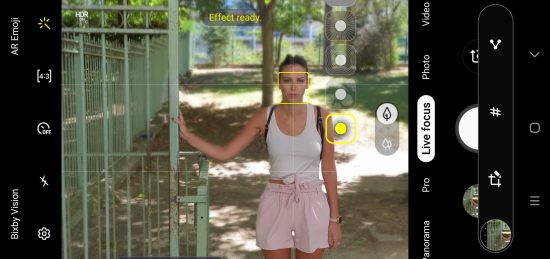
Preview: in portrait manner, bokeh activation and face detection are confirmed via on-screen text and symbols.

Capture: blur intensity and gradient are consistent with the preview image, but depth interpretation is noticeably different.
When pinch zooming, jumps in field of view are evident as the device switches between its three camera modules. Some focus breathing issues are also evident, especially using the zoom magnification buttons, where the device takes a 2d or two to snap the image sharp. Slight exposure and white remainder instabilities are also visible nether all lighting conditions, but we considered them generally adequate, specially when using the zoom magnification buttons.
Samsung Galaxy Note 10+ 5G, zoom preview
Samsung Galaxy Note10+ 5G Camera update review (originally published September 18, 2019)
Please note: In September 2019, we updated the DXOMARK Mobile test protocol to encompassultra-broad-angle functioning and have renamed the protocolDXOMARK Camera. We also expanded our low-light testing and created the newNight sub-score, which incorporates the previous Wink score. We accept retested this device using the new Wide and Night test protocols and updated this review. The updated elements and scores are right at the top; you can still find the original review further down the page. For more information, delight meet the articles about our new Broad and Night test protocols.
The Samsung Galaxy Note 10+ 5G is the South Korean manufacturer'south latest flagship smartphone, combining the processing power of the Exynos 9825 chipset with a large 6.8-inch AMOLED display and 12Gb of RAM. The rear camera comes with iv sensors: a standard 26mm master camera, a 13mm ultra-broad camera, a 52mm tele-lens, and a dedicated Fourth dimension-of-Flight (ToF) sensor for depth estimation in Portrait way. Read on to find out how the Annotation ten+ 5G performed in our new Wide and Dark tests, as well as in our other test categories.
The Samsung Galaxy Annotation ten+ 5G achieves the highest scores among devices tested and then far for both of our new Wide and Dark test categories, thereby increasing its Photo score by 8 points and pushing its DXOMARK Camera overall score to a record high 117 points, upwardly from 113. This ways that it's notwithstanding ahead of the S10 5G and Huawei P30 Pro by i point in our updated ranking.
The Samsung'southward broad-angle camera delivers the all-time performance we have seen in outdoor conditions, and is amidst the best for indoor lighting. At 12mm equivalent, it covers a wider field of view than most of its directly competitors and however manages to produce skilful image quality across the entire wide zoom range up to 20mm equivalent. Exposure, colour, and detail are skillful in nigh weather, and it controls distortion well. Some other artifacts, however, including ringing and chromatic aberrations, can be visible in some situations.
At 59 points (the best score in our new Nighttime test), the Note 10+ 5G is tied with its cousin S10 5G and the Huawei P30 Pro at the elevation spot. The Samsung delivers a standout performance with the flash forced on, but images taken in flash-car and flash-off modes generally evidence good exposure likewise. There's room for improvement in terms of item and noise, even so. The device offers a dedicated Dark manner which can achieve better exposures than the default shooting mode, but is not an improvement in terms of paradigm detail.

Wide
Samsung Galaxy Note 10+ 5G (Exynos)
42
58
Honor Magic4 Ultimate
Best: Award Magic4 Ultimate (58)
The Note 10+ 5G is the all-time device we have tested and so far with our new Wide test protocol. Thanks to the best functioning in outdoor conditions and image quality that is amidst the best under indoor lighting, it achieves an fantabulous score of 42 points.
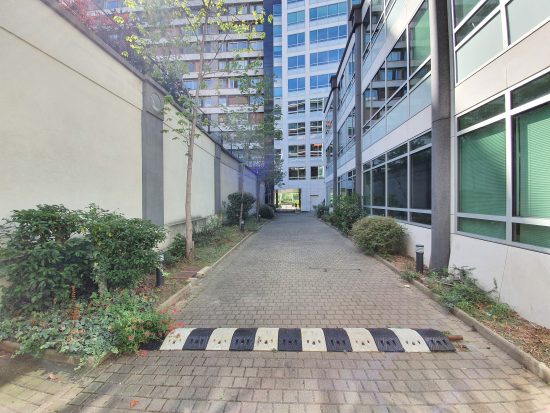
Samsung Galaxy Note 10+ 5G, 12mm field of view
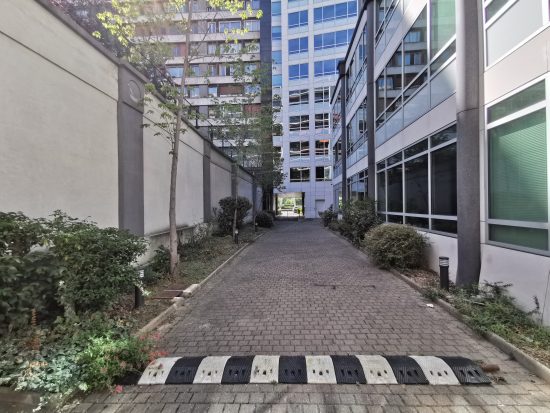
Huawei P30 Pro, 16mm field of view
At 12mm equivalent, the Notation 10+ 5G offers a wider field of view than many of its direct competitors and still manages to maintain skillful image quality across all tested focal lengths (from 12 to 20mm equivalent). Target exposure tends to be accurate and images testify a wide dynamic range, with clipping observed only indoors. Color rendering is skillful, producing vivid and pleasant colors, and the auto white balance system produces good results even nether artificial lighting.

Samsung Galaxy Annotation 10+ 5G, outdoor color rendering

Huawei P30 Pro, outdoor color rendering

Lenovo Z6 Pro, outdoor color rendering
Every bit for detail, the Samsung does well in outdoor conditions but loses some points when shooting under typical indoor lighting. Noise is quite visible in blueish skies, fifty-fifty when shooting in vivid light, and dissonance levels indoors are slightly higher than the best-in-class devices.

Samsung Galaxy Note 10+ 5G, outdoor detail
Samsung Milky way Note 10+ 5G, crop, outdoor particular

Samsung Galaxy Note 10+ 5G, indoor detail
Samsung Galaxy Note 10+ 5G, crop, indoor detail
Equally with pretty much any wide-angle camera, some artifacts are visible in Note 10+ 5G images, but distortion is well-corrected and only slightly visible in the corners of the frame. At minimum focal length, face up deformation (anamorphosis) tin be quite intrusive on people shut to the edges of the frame, and chromatic aberrations can be often be spotted along high-contrast edges as well. In addition, our testers also saw some ringing and a slight loss of sharpness towards the corners of the frame. Overall, though, the Annotation 10+ 5G controls artifacts pretty well, especially when considering the photographic camera's very wide field of view.

Samsung Milky way Note ten+ 5G, chromatic aberrations
Samsung Galaxy Note 10+ 5G, crop, chromatic aberrations
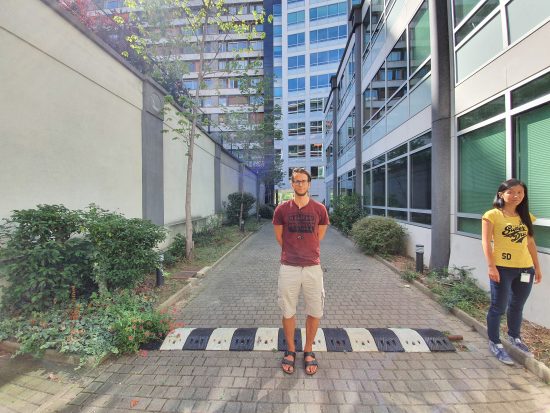
Samsung Milky way Note x+ 5G, anamorphosis
Samsung Milky way Note 10+ 5G, ingather, anamorphosis

Night
Samsung Galaxy Annotation 10+ 5G (Exynos)
59
82
Huawei Mate 40 Pro+
Best: Huawei Mate forty Pro+ (82)
At 59 points, The Note ten+ 5G is tied with the S10 5G and the Huawei P30 Pro for the best score in our new Nighttime exam. There's yet room for improvement, simply as far as electric current smartphones get, Samsung's flagship is every bit good as it gets for low-light photography.
When shooting in wink-machine manner, the flash occasionally triggers for mural shots, fifty-fifty when it'south non capable of illuminating much of the scene. More sensibly, it mostly triggers when information technology detects a face up in the frame. The resulting people pictures usually bear witness expert target exposure on faces, but if the scene is not illuminated by an ambient low-cal source, the background tends to exist completely black. Dynamic range is also depression, with some clipping either in the highlight or shadow areas. The level of captured image detail is pretty low, too.

Samsung Milky way Notation 10+ 5G, flash-auto portrait
Samsung Galaxy Note 10+ 5G, crop, low levels of detail

Lenovo Z6 Pro, flash auto portrait
Lenovo Z6 Pro, crop, acceptable detail
With the flash switched off, images show skilful exposure in night cityscapes, just detail is low and images show visible luminance noise. In extremely depression lite, the Notation 10+ 5G is not capable of achieving correct exposure, and images tend to be strongly underexposed.

Samsung Galaxy Annotation ten+ 5G, night cityscape
Samsung Galaxy Note 10+ 5G, crop, depression levels of detail and dissonance

Huawei P30 Pro, night cityscape
Huawei P30 Pro, good detail, depression noise
Exposure can be improved using the defended night manner, which is capable of producing brighter pictures than default photo manner, even in very dim conditions. This said, exposure is not every bit bright as in images captured with the Huawei P30 Pro's night mode, and the level of captured item remains low.

Samsung Galaxy Note 10+ 5G, default mode
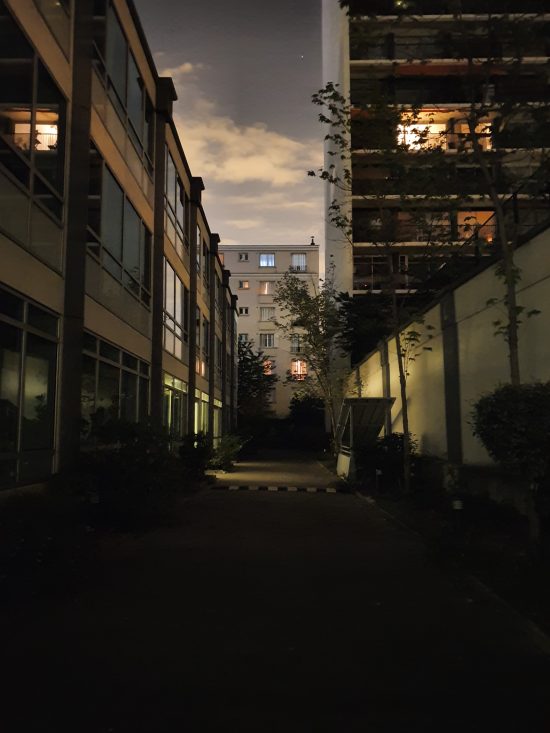
Samsung Galaxy Note x 5G, night mode
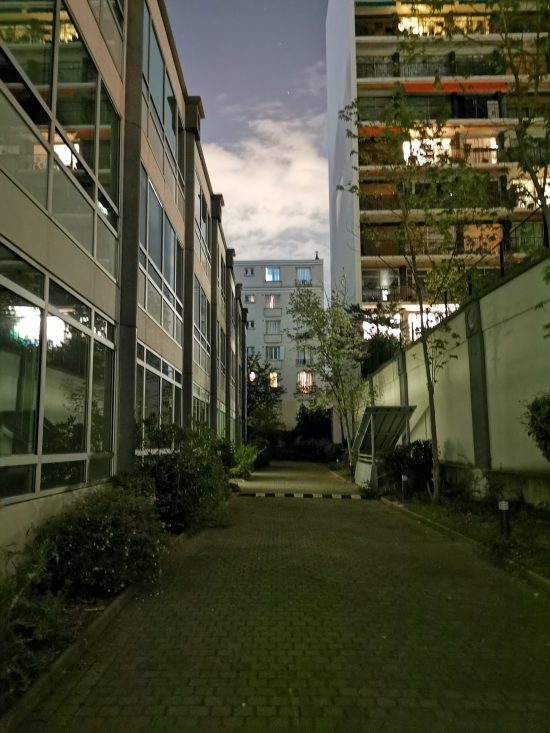
Huawei P30 Pro, dark mode
In very low light, your best choice might be to strength the flash on. In this manner, the Samsung delivers excellent results in both wink-merely and mixed-lighting scenarios. There's some vignetting and color shading, but portraits have nice skin tones (thanks to accurate target exposure and white balance when flash is the only light source); details are also well-preserved and vignetting is minimal. Mix in a little tungsten bogus lighting (five lux), and flash shots remain very skilful on the Note x+ 5G. Exposure and white residual remain accurate and very stable, and the Samsung achieves consistent results over consecutive shots.
Samsung Milky way Annotation ten+ 5G camera review (originally published August 12, 2019)
The Samsung Milky way Note ten+ 5G is the South Korean manufacturer's latest flagship "phablet," featuring a massive half dozen.8-inch AMOLED display with 1440 x 3040 (495 ppi) resolution. Powered past the high-terminate Exynos 9825 chipset, with a whopping 12Gb of RAM, there's plenty of processing to handle a heavy work load.
The photography proposition offers no fewer than four sensors: a standard 26mm primary camera, a 13mm ultra-wide photographic camera, a 52mm tele-lens, and a dedicated Time of Flight (ToF) sensor for depth estimation in Portrait mode. The primary camera uses a 12Mp sensor with 1.4µm pixels coupled to a variable-aperture f/i.5-two.iv lens with dual-pixel autofocus and Optical Prototype Stabilization (OIS). The ultra-wide angle boasts a higher-resolution 16Mp sensor with i.0µm pixels and a fixed-aperture f/ii.2 lens. The tele-camera comes with a 12Mp-resolution sensor and a slightly brighter f/2.1 aperture lens on the Note 10+ 5G compared to the S10 5G.
The device captures 4K video at 30fps in default mode, with 60fps bachelor. We've put Samsung's latest flagship through our comprehensive testing protocol. Read our full review to find out how it performed.
Key camera specifications:
- Quad-photographic camera, including ToF sensor
- Primary: 12Mp sensor with i.4µm pixels, 26mm (equivalent) variable-aperture f/one.5-two.4 lens, dual-pixel AF, OIS
- Ultra-broad: 16Mp sensor with 1.0µm pixels, 13mm (equivalent) f/2.2-aperture lens
- Tele: 12Mp sensor with 1.0µm pixels, 52mm (equivalent) f/2.one aperture lens, PDAF, and OIS
- 4K video, 2160p/60fps (2160p/30fps default)
Nigh DxOMark Mobile tests: For scoring and assay in our smartphone camera reviews, DxOMark engineers capture and evaluate over 1500 examination images and more than than two hours of video both in controlled lab environments and in natural indoor and outdoor scenes, using the photographic camera's default settings. This article is designed to highlight the most of import results of our testing. For more data almost the DxOMark Mobile test protocol, click here. More details on how nosotros score smartphone cameras are available hither.
Test summary
Achieving a DxOMark Mobile score of 113 points, the Samsung Galaxy Note ten+ 5G becomes the top-ranked device for smartphone paradigm quality in our database. An excellent performance across the board means that whether yous're shooting photos or videos, y'all can be confident of getting outstanding results from Samsung's latest flagship device. While the scores are broadly similar to its stablemate Galaxy S10 5G, some fine-tuning of the processing algorithms has improved on the splendid epitome quality previously observed on Samsung premium devices.
For still photos, the Notation ten+ 5G'south DxOMark Photo score of 118 ranks second in our database, only a point behind the Huawei P30 Pro. Exposures are consistent and accurate across a range of lighting conditions, with excellent results. The Note x+ 5G likewise boasts very broad dynamic range when capturing images in very vivid or in loftier-contrast conditions, where highlight and shadow detail is well-preserved and exposure on faces is generally spot on.

The Samsung Galaxy Annotation 10+ 5G offers excellent exposure with wide dynamic range, bold color, and loftier levels of detail in a range of lighting atmospheric condition.
By and large neutral white balance, accurate rendering, and high levels of saturation ensure that color is brilliant and pleasant in nigh tested conditions. Samsung has stuck with a 12Mp resolution for the Note 10+ 5G, simply the sensor still manages to pack in enough of detail, with especially well-defined edges and intricate elements visible in adept lighting weather condition. Information technology's not the best device we've tested for noise, which can quondam get visible in lower light atmospheric condition, but broadly speaking, the Notation ten+ 5G manages the texture-versus-racket trade-off well.

Samsung Galaxy Annotation x+ 5G, outdoor portrait

Samsung Galaxy Note x+ 5G, outdoor scene
Providing an optical zoom solution at 2x magnification, the 52mm-equivalent lens records very high levels of detail, low racket, and good color in shut-range zoom shots. It's not quite as skillful at longer focal lengths when the digital zoom processing kicks in, but with a pocket-size corporeality of pinch, zoom detail holds up well in good light, and bated from some minor noise and artifacts, epitome quality is reasonably well-controlled. Samsung has also improved the bokeh simulation in the Note 10+ 5G's Portrait mode, too, with notably better texture on faces compared to the S10 5G. Subject isolation is mostly very adept as well, and a mild but pleasant depth-of-field effect includes dainty spotlights and a realistic transition effect that blurs objects both in front and backside the subject.

Samsung Galaxy Note ten+ 5G, close-range zoom

Samsung Galaxy Annotation ten+ 5G, bokeh simulation
Add to all that a fast, accurate and reliable autofocus system and an effective flash module, and the Annotation ten+ 5G delivers top-notch images across a variety of shooting scenarios.
Video performance is no less impressive, and a DxOMark Video score of 101 points makes the Annotation ten+ 5G the all-time overall device for capturing moving images that we've tested so far. Video exposures are accurate in almost all weather condition, with fairly wide dynamic range ensuring good particular in the highlights when capturing videos in bright or loftier-contrast atmospheric condition. Video color is usually vivid and bright, too, and the Annotation 10+ 5G is capable of loftier levels of detail in its 4K videos, with well-managed levels of noise in both indoor and outdoor lighting conditions. Video autofocus is also fast and accurate, with good subject tracking; together with an effective stabilization system, you can be confident of overnice polish playback of movie files.
Samsung Milky way Annotation ten+ 5G, outdoor video
Samsung Galaxy S10 5G, outdoor video
Apple iPhone XS Max, outdoor video
Photo scores explained
The Galaxy Notation x+ 5G's 2nd-identify Photo score of 118 points is calculated from sub-scores in tests that examine different aspects of a device's performance for still images nether unlike lighting conditions. In this section, we take a closer look at how these sub-scores were adamant and compare image quality against some key competitors.

Exposure and Contrast
Samsung Galaxy Note 10+ 5G (Exynos)
96
111
Honor Magic4 Ultimate
Best: Honor Magic4 Ultimate (111)
The Note ten+ 5G is a top performer for exposure, with skilful scores in all lighting conditions and slightly better measurements compared to the S10 5G in very bright low-cal. Tested in the lab, target exposures are good in all lighting conditions betwixt 5 and one thousand lux, with high levels of dissimilarity ensuring pleasant results. In about-dark atmospheric condition of 1 lux, it's non quite as good every bit the P30 Pro, which produces the brightest images in these conditions, but it'due south noticeably better than the iPhone XS Max.
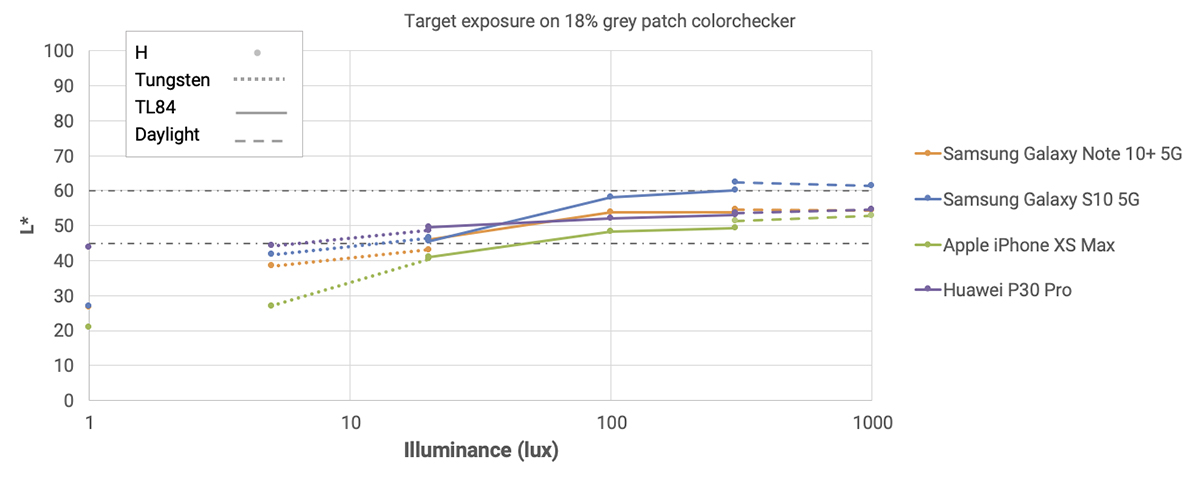
Samsung Galaxy Note 10+ 5G, target exposure comparison
HDR processing is excellent in bright weather condition outdoors, and in our challenging shady portrait test scene, the Notation 10+ 5G achieved the best upshot, with cracking exposure of both the portrait and the background. The P30 Pro retained the virtually highlight item of the three devices, only the Notation x+ 5G accomplished meliorate exposure in the shadow areas, as both the both the P30 Pro and iPhone XS Max underexposed the field of study and the darker regions in their shots.

Samsung Galaxy Notation 10+ 5G, high-contrast scene

Huawei P30 Pro, loftier-contrast scene

Apple iPhone XS Max, loftier-contrast scene
HDR rendering isn't quite equally good indoors, but the Notation 10+ 5G achieved good target exposures overall, and reasonably bright images in challenging indoor scenes. In our back-lit indoor portrait, it also preserved highlights well in the bright areas exterior the window, but the target exposure on the subject's face was slightly low.

Samsung Galaxy Note 10+ 5G, back-lit portrait

Huawei P30 Pro, back-lit portrait

Apple iPhone XS Max, back-lit portrait

Color
Samsung Milky way Note x+ 5G (Exynos)
88
107
Apple iPhone xiii Pro Max
Best: Apple tree iPhone xiii Pro Max (107)
An splendid score for color, and although information technology drops a indicate behind the class-leading S10 5G in this category, the Note x+ 5G remains a very proficient performer, with generally accurate white remainder and pleasant color rendering in all lighting atmospheric condition. Color is particularly vibrant in outdoor images, and although high levels of saturation in sunny weather might be too strong for some tastes, there's no denying that the hues really pop. It'due south not quite equally impressive in cloudy conditions, with a slightly blueish color cast evident, only it'southward non overly problematic and color remains strong.

Samsung Galaxy Note 10+ 5G, outdoor color

Huawei P30 Pro, outdoor colour

Apple iPhone XS Max, outdoor colour
Colors go on to be bold and well-saturated in indoor images, with accurate white balance generally achieved nether a range of artificial light sources and mixed lighting atmospheric condition.

Samsung Galaxy Note x+ 5G, indoor color

Huawei P30 Pro, indoor color

Apple iPhone XS Max, indoor colour
The Notation 10+ 5G dropped a indicate compared to the S10 5G due to a slightly pinkish color cast and some minor colour shading in low-lite lab measurements, only both bug are far from apropos.
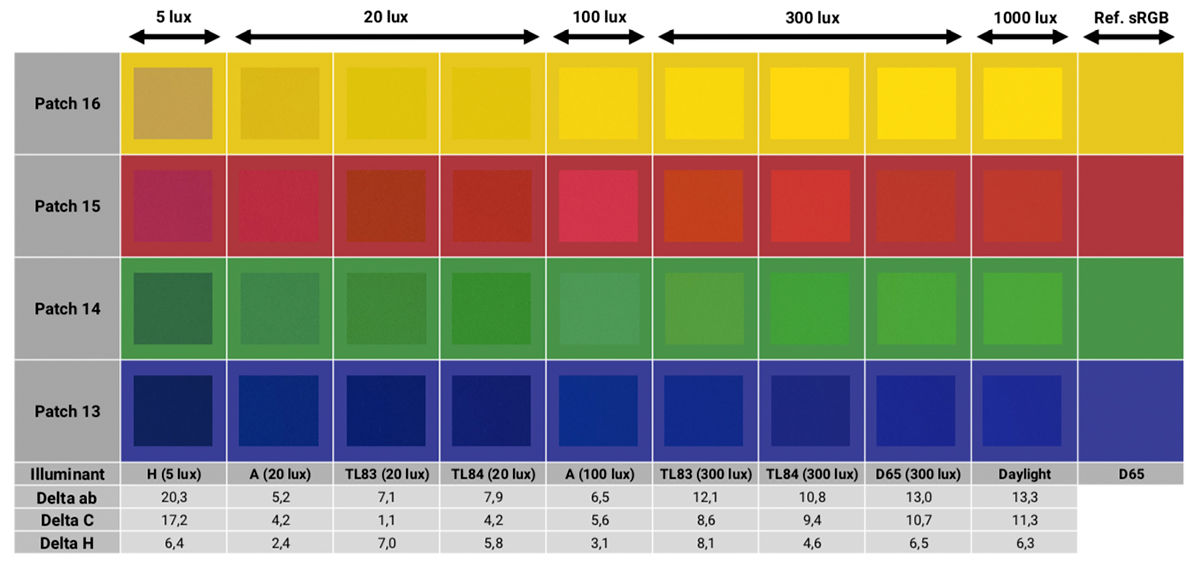
Samsung Galaxy Note x+ 5G, color assay past lighting atmospheric condition

Autofocus
Samsung Galaxy Note 10+ 5G (Exynos)
99
109
Asus Smartphone for Snapdragon Insiders
Best: Asus Smartphone for Snapdragon Insiders (109)
The Notation 10+ 5G achieves outstanding results for autofocus, which is fast, accurate and reliable in all lighting conditions. Samsung's latest device matches the overall autofocus score of 99 points of the S10 5G and is simply a indicate backside the top-ranked devices in this category (east.one thousand., the P30 Pro and iPhone XS Max). This small difference is more often than not due to the fact that the Samsung, unlike the Huawei and Apple devices, does not come with a raw buffer that allows for automatic pick of the all-time image from a burst. The Note 10+ doesn't feature negative shutter lag either, just the autofocus is very quick and consistent. During our benchmark autofocus tests in which we defocus the device between shots and look either a short (500 ms) or long (2000 ms) filibuster before requesting focus, the new Samsung consistently snapped into sharp focus in super-quick time.
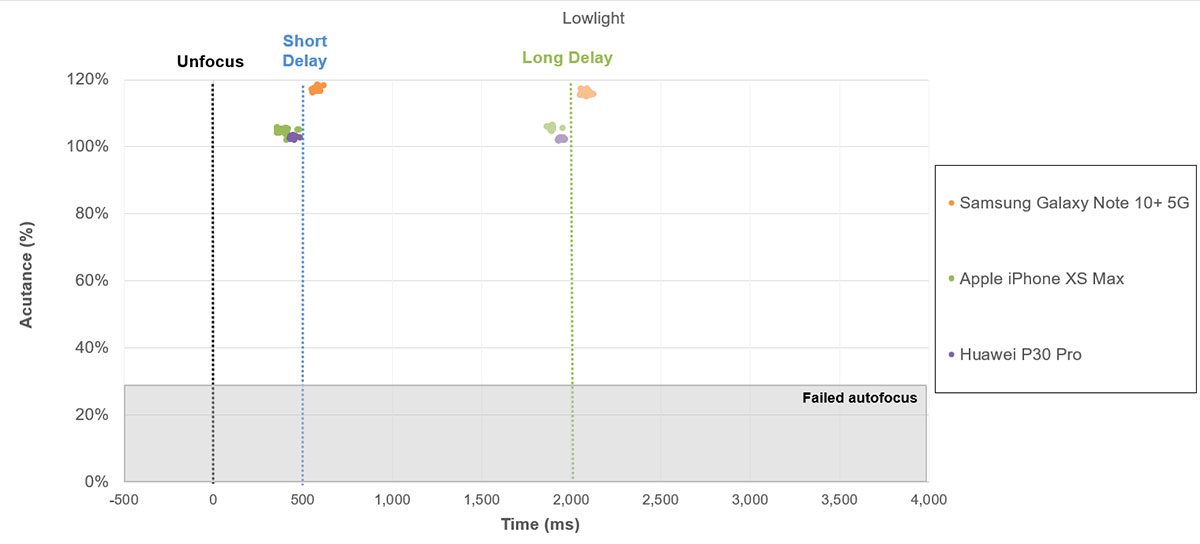
Samsung Milky way Note x+ 5G, depression light (20 lux) autofocus performance versus competitors

Texture
Samsung Galaxy Note 10+ 5G (Exynos)
72
111
Xiaomi Mi 11
Best: Xiaomi Mi 11 (111)

Noise
Samsung Milky way Notation 10+ 5G (Exynos)
77
102
Honor Magic4 Ultimate
Best: Honor Magic4 Ultimate (102)
The Note ten+ 5G displays a very pocket-size improvement in detail preservation over the S10 5G, gaining an extra point over its stablemate in the texture category along with practiced results in all lighting weather. Tested in the lab, static images display exceptional particular of around 80% acutance betwixt indoor (100 lux) and outdoor (m lux) lighting conditions, with texture preservation dropping only slightly in low-light conditions (5 lux).
The Note x+ 5G is likewise very adept with scenes containing motion under indoor and outdoor lighting conditions, with acutance of around lxx%, making it a good option for shooting moderate subject area movement such as child portraits or street scenes. Equally with its competitors, subject motion isn't besides-defined in low-calorie-free conditions, only it'south acceptable and about as skillful as yous can currently go with a smartphone.
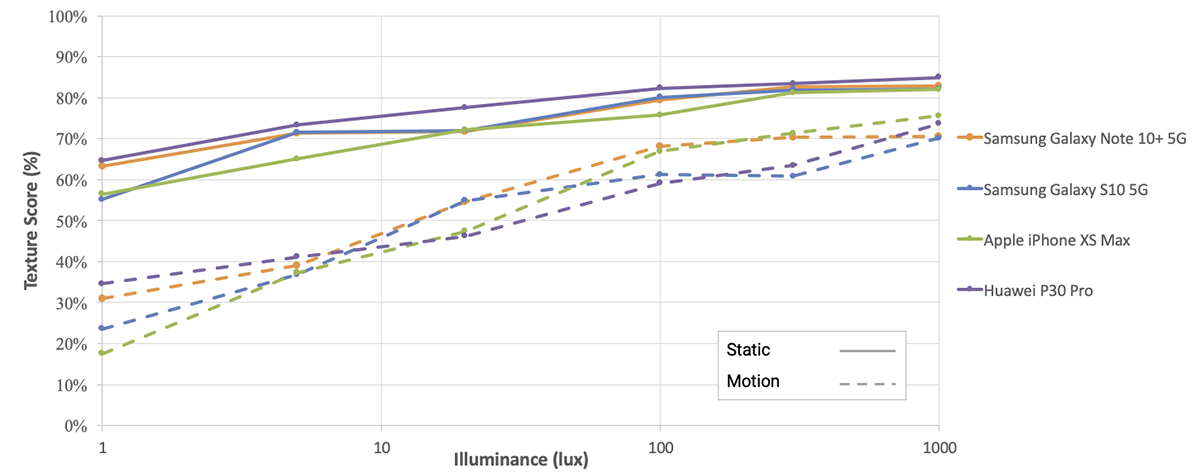
Samsung Galaxy Note 10+ 5G, texture comparison
Scoring a maximum of 10 in our perceptual analysis of particular in outdoor images, the Note x+ 5G is up there with the best performers in brilliant conditions, with intricate areas more often than not very well-defined. The only exception is some loss of detail in the dark areas in high-contrast scenes when the main bailiwick is close to the photographic camera; further, backgrounds are slightly softer if the camera uses its wide f/1.5 lens aperture setting. The Note 10+ 5G also controls luminance racket well in vivid flat areas like the heaven in outdoors images, although under close inspection dissonance is occasionally visible in the darker areas.
When viewing closely the comparison samples below, you can meet that both the Note x+ 5G and the S10 5G are capable of rendering excellent fine detail in bright light, but are merely edged out by the Apple iPhone XS Max, which is even so the class leader for brilliant-calorie-free detail.

Samsung Milky way Note 10+ 5G, outdoor item
Samsung Galaxy Note 10+ 5G, crop

Samsung Milky way S10 5G, outdoor detail
Samsung Galaxy S10 5G, crop

Apple iPhone XS Max, outdoor detail
Apple tree iPhone XS Max, crop
Equally lite levels drop, the Notation ten+ 5G handles the texture-versus-racket trade-off well, and some fine-tuning by the Samsung engineers has improved it fractionally over the S10 5G in depression-calorie-free weather condition. Noise is sometimes visible in the darker areas of indoor images, and the P30 Pro offers cleaner results, especially in farthermost low light, but the Notation 10+ 5G isn't far behind and is ameliorate than the iPhone XS Max, which can get quite noisy.
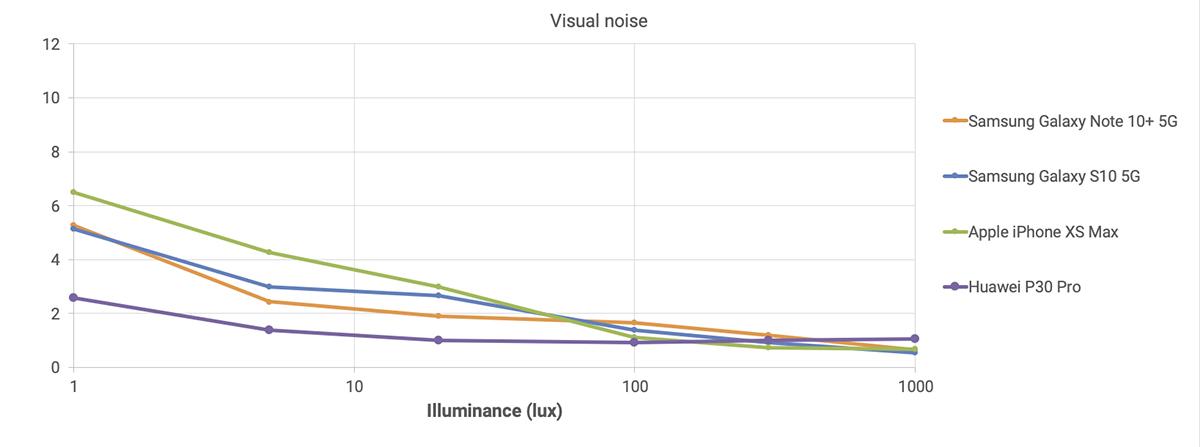
Samsung Galaxy Note 10+ 5G, visual noise comparison
Shooting natural exam scenes indoors, the results for the Samsung and Apple models almost match that of the P30 Pro, although the latter's slight reward for detail and noise is articulate.
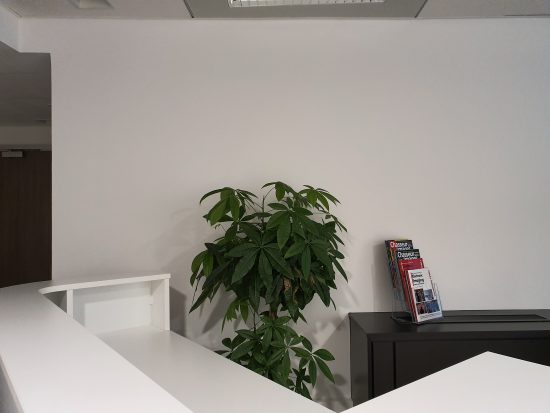
Samsung Milky way Notation 10+, indoor noise and detail
Samsung Galaxy Note 10+, ingather
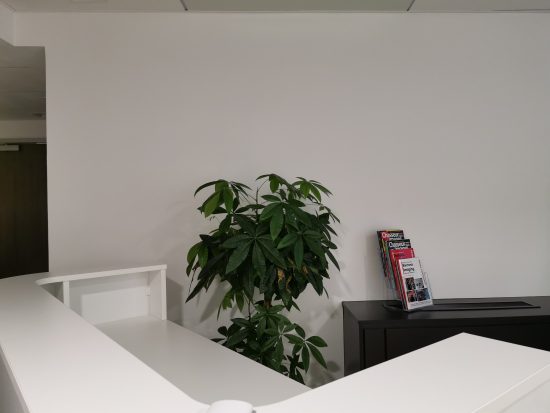
Huawei P30 Pro, indoor noise and detail
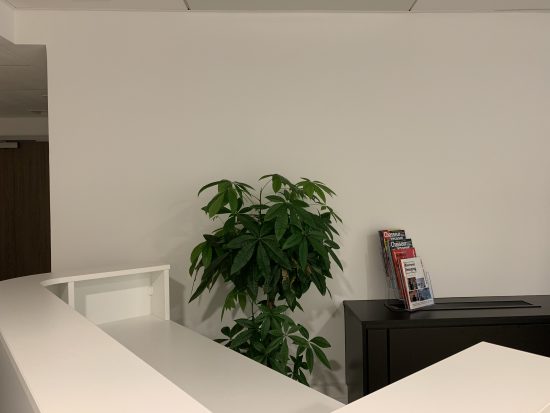
Apple iPhone XS Max, indoor dissonance and detail
Apple iPhone XS Max, ingather
In depression low-cal (20 lux), the P30 Pro remains out in front end. But betwixt the Notation ten+ 5G and iPhone XS Max runners-upward, yet, the Samsung device displays less visual noise, just too less conspicuously-defined fine detail than its closest rival.

Milky way Notation 10+ 5G, noise and detail, 20 lux

Huawei P30 Pro, noise and particular, 20 lux

Apple iPhone XS Max, noise and detail, twenty lux
Apple iPhone XS Max, crop

Wink
Samsung Galaxy Note x+ 5G (Exynos)
96
The Note ten+ 5G offers a very constructive flash solution, with excellent results in both wink-simply and mixed-lighting scenarios. That said, it'south a slight regression from the outstanding performance of the S10 5G, with wink shots from the Note displaying slightly more vignetting and colour shading. Annotation shots are marginally better using wink as the only calorie-free source (0 lux), where accurate target exposure and white balance ensure prissy skin tones on portraits; details are too well-preserved and vignetting minimal. Flash results at 0 lux are broadly like to those of the P30 Pro and are a notable comeback over the iPhone XS Max, which isn't great for wink, showing serious underexposure and evident vignetting.

Samsung Galaxy Note 10+ 5G, flash at 0 lux

Huawei P30 Pro, flash at 0 lux

Apple tree iPhone XS Max, wink at 0 lux
Mix in a petty tungsten artificial lighting (5 lux) and wink shots remain very good on the Note 10+ 5G. Exposure and white residual remain accurate and very stable, and the smartphone achieves consistent results over consecutive shots. And then it'due south but for the slight increase in vignetting and some color shading where the Note 10+ 5G dropped a couple of points for wink.
The Note ten+ 5G achieves a proficient score for artifacts. While some minor problems exist, they're by and large noticeable only when viewing images at big calibration and aren't too detrimental to image quality overall. The principal penalties we applied were for ringing along loftier-dissimilarity edges, as well as for aliasing, and for maze and moiré patterns, which are visible in about images. We also observed some other issues, such every bit some geometric distortion, ghosting, flare, fringing, color quantization, and a loss of sharpness in the corners of the frame, merely these artifacts occur less ofttimes. So overall, while the Note x+ 5G isn't quite as potent as such top performers for artifacts as the iPhone XS Max, the problems are fairly minor on the whole.

Samsung Galaxy Note x+ 5G, moiré artifact
Samsung Milky way Annotation 10+ 5G, crop
Samsung Galaxy Note ten Plus 5G, aliasing artifact
Samsung Galaxy Annotation ten Plus 5G, crop

Samsung Galaxy Note 10 Plus 5G, ringing artifact
Samsung Galaxy Note 10 Plus 5G, ingather

Zoom
Samsung Galaxy Note 10+ 5G (Exynos)
76
Achieving 76 points for zoom, the Annotation 10+ 5G is i of the all-time-performing devices we've tested. Thank you to slightly amend texture observed in images shot in the lab, the Note posts a pocket-sized improvement of 2 points over the S10 5G'due south score. Ameliorate texture is especially noticeable in indoor and depression-low-cal conditions, where the new model benefits from its slightly wider discontinuity; otherwise, the two devices are very comparable. The Note ten+ 5G's 52mm-equivalent tele-lens is an excellent performer in all lighting conditions for shut-range zoom, and results remain very acceptable at medium range in both outdoor and indoor lighting conditions, too. In fact, the Note 10+ 5G records the best fine detail in vivid light that we've seen in close-range zoom shots (2x magnification), with a small-scale improvement in edge rendering compared to the P30 Pro and a pregnant improvement over the iPhone XS Max.

Samsung Galaxy Annotation ten+ 5G, close-range zoom
Samsung Milky way Notation ten+ 5G, crop

Huawei P30 Pro, close-range zoom

Apple iPhone XS Max, close-range zoom
Apple iPhone XS Max, crop
At medium range (~4x magnification), some ringing, hue shifts and color quantization start to get visible on shut inspection, only the Note 10+ 5G continues to handle racket pretty well and particular remains proficient in bright light. The P30 Pro remains the leader for long-range zoom (~8x magnification), however, so expect to see a loss of detail in the Note 10+ 5G's long-range zoom shots compared to the P30 Pro; this said, the Samsung device does a fractionally ameliorate job than the iPhone XS Max at these long distances.

Samsung Milky way Annotation 10+ 5G, long-range zoom
Samsung Milky way Note 10+ 5G, crop

Huawei P30 Pro, long-range zoom

Apple iPhone XS Max, long-range zoom
Apple tree iPhone XS Max, ingather
In indoor zoom shots, the Note 10+ 5G continues to offering reasonable texture and item preservation and is a slight improvement over the S10 5G. A little more than racket and lower levels of detail are again evident compared to the P30 Pro, but the Note 10+ 5G continues to be better than the iPhone XS Max for indoor zoom at medium range.

Galaxy Notation 10+ 5G, medium-range zoom indoors

Huawei P30 Pro, medium-range zoom indoors

Apple iPhone XS Max, medium-range zoom indoors
Apple iPhone XS Max, crop

Bokeh
Samsung Galaxy Note 10+ 5G (Exynos)
75
80
Huawei P50 Pro
Best: Huawei P50 Pro (fourscore)
An outstanding effect for bokeh, with the Note 10+ 5G the first device to reach 75 points in this category. This is only a pocket-size improvement over what was already a very good bokeh implementation on the S10 5G, simply slightly better field of study isolation, spotlight rendering, gradient mistiness, and particularly texture on faces are all noticeably ameliorate. Better texture on faces is once more likely due to the slightly wider aperture on the Note 10+ versus the S10 5G.
Depth estimation isn't perfect, with some slight masking errors and artifacts occasionally visible, but a pleasant depth-of-field effect is consistently practical to both portraits and static objects when requested and mistiness transitions look natural, with objects both in front end and behind the subject blurred.

Samsung Galaxy Notation 10+ 5G, bokeh outdoors
Samsung Galaxy Note ten+ 5G, crop

Huawei P30 Pro, bokeh outdoors

Apple tree iPhone XS Max, bokeh outdoors
Apple iPhone XS Max, ingather
Using Portrait style indoors, texture rendering on faces has improved over the S10 5G, besides; further, there is more detail compared to the P30 Pro, and less noise than the iPhone XS Max, thus giving the Note ten+ 5G the advantage for indoor bokeh shots.

Samsung Milky way Note x+ 5G, bokeh indoors
Samsung Galaxy Note ten+ 5G, crop

Samsung Galaxy S10 Plus 5G, bokeh indoors
Samsung Galaxy S10 Plus 5G, ingather

Apple iPhone XS Max, bokeh indoors
Apple iPhone XS Max, crop
The HDR in the Note x+ 5G'southward bokeh shots is as well improved with respect to the S10 5G in high-contrast scenes, with ameliorate brightness in the shadows in portraits when the groundwork is much brighter. The spotlight outcome is also enhanced, with a skilful shape and contrast to the background bokeh, which the Note also renders more than regularly. The only downside to the Note ten+ 5G's bokeh simulation is a slight lack of contrast that tin brand images look a trivial apartment in the shadows.

Galaxy Note 10+ 5G, bokeh high-contrast scene

Milky way S10+ 5G, bokeh high-dissimilarity scene

Apple iPhone XS Max, bokeh high-contrast scene
Apple iPhone XS Max, crop
Video scores explained
With an overall Video score 101 points, the Samsung Galaxy Note 10+ 5G is a top performer for capturing moving images. The overall Video score is derived from performance and results across a range of attributes in the same way as the Photo score: Exposure (87), Colour (90), Autofocus (96), Texture (73), Racket (79), Artifacts (84), and Stabilization (93).
Tested under lab conditions, the Note ten+ 5G offers excellent target exposures in videos shot nether light sources between v and 1000 lux, and its results are very similar to those of the S10 5G and the P30 Pro. With the ideal range for target exposures between 40 and 60 L*, the Samsung, Apple, and Huawei devices offer skilful target exposures downwardly to around 10 lux, merely the Annotation 10+ 5G's exposures are generally a fiddling brighter compared to the iPhone XS Max's. In extreme depression lite below 5 lux, target exposures hold upwards a lilliputian better on the P30 Pro, just the Note 10+ 5G's videos remain just about usable in these conditions.

Samsung Milky way Note 10+ 5G, video target exposure comparison
Dynamic range is fairly broad in the Note 10+ 5G'south videos, besides, with the device generally preserving expert detail in the highlights in loftier-contrast weather condition. It'due south not quite every bit good every bit the iPhone XS Max, though, every bit the Apple tree device records more detail in the shadow regions in brilliant outdoor scenes and provides smoother exposure transitions every bit the light changes.

Galaxy Note x+ 5G, video nonetheless

Samsung Galaxy S10 5G, video still

Apple tree iPhone XS Max, video still
Color is generally bright and vivid, with particularly assuming hues in the Note 10+ 5G'southward outdoor and indoor videos. Color is a little undersaturated in lower lite conditions, but it remains acceptable. White residuum is mainly accurate, as well, with the exception of a slight pinkish color bandage visible in the Note 10+ 5G's low-calorie-free videos.
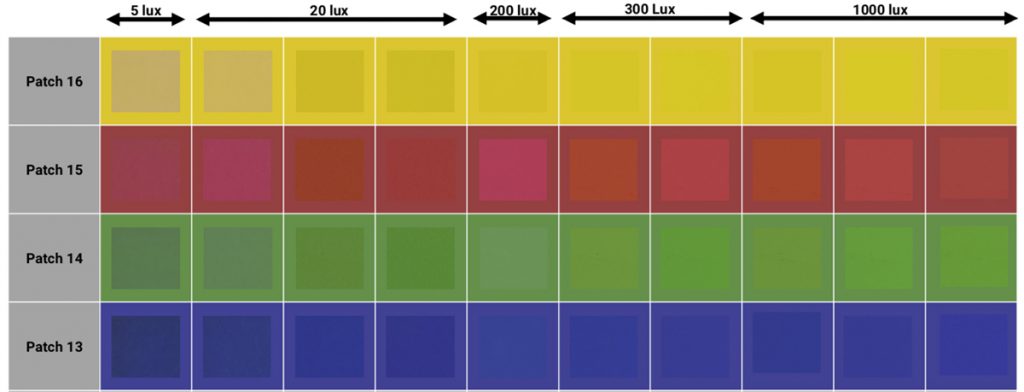
Samsung Galaxy Note 10+ 5G, video color analysis
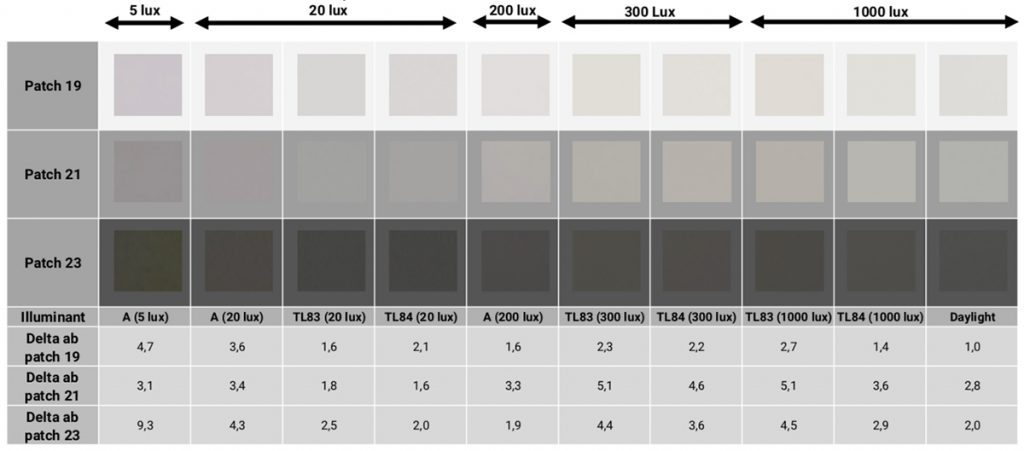
Samsung Galaxy Note x+ 5G, video white rest analysis
Detail preservation is another forcefulness for the Note ten+ 5G's videos, and Samsung has managed to improve texture over the S10 5G in low-calorie-free and indoor weather condition. In both indoor (100 lux) and outdoor (one thousand lux) conditions, the Note 10+ 5G's 4K-resolution videos achieve excellent texture acutance scores of over lxxx%, with noticeably sharper particular compared to the 1080p files that the iPhone XS Max and P30 Pro capture in default mode. The Samsung too records more detailed textures than the P30 Pro and XS Max in indoor conditions, just it is not quite every bit good as other 4K devices such as the OnePlus seven Pro. In low low-cal, the Samsung applies fairly potent noise reduction that results in a noticeable drib in texture acutance.
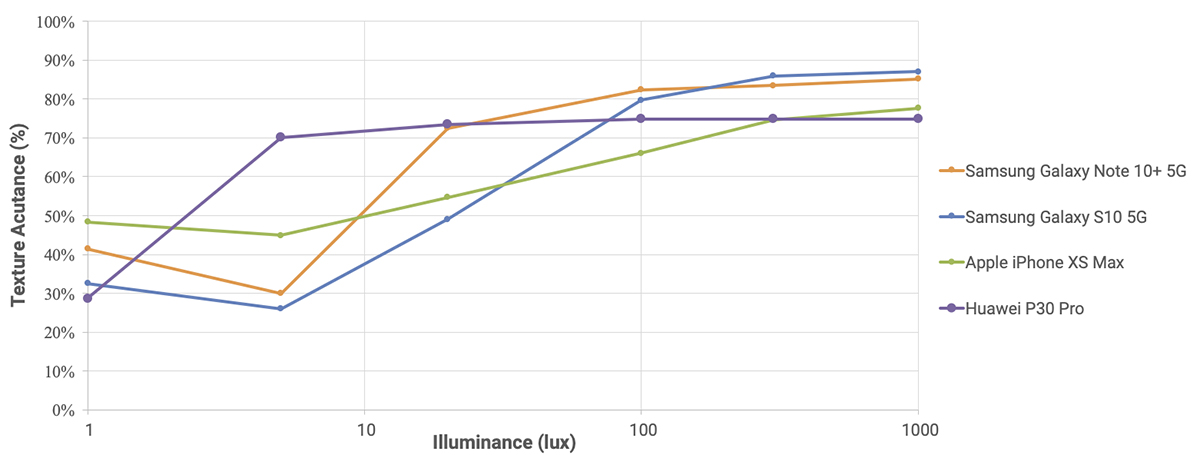
Samsung Milky way Note 10+ 5G, video texture comparing

Samsung Milky way Notation 10+ 5G, video texture

Samsung Galaxy S10 5G, video texture

Apple iPhone XS Max, video texture
The crops below bear witness the same image surface area in each video withal (unlike the 100% crops we otherwise employ throughout this review) to illustrate the resolution advantage you lot become from the Note 10+ and S10 4K video mode over the iPhone's 1080p resolution.

Samsung Galaxy Notation 10+ 5G, crop

Samsung Galaxy S10 5G, crop

Apple iPhone XS Max, crop
The Note 10+ 5G handles noise very well in nigh lighting weather condition, so you tin can expect clean indoor and outdoor videos more often than not. It's non and so proficient in low-light conditions, all the same, where a build-upwards of a strong coarse noise is often evident. You lot can see against its primary competitors that the Note ten+ 5G's temporal noise is generally lower in skilful lighting conditions, while the P30 Pro is a little cleaner in low light down to 5 lux and again noticeably ameliorate in extreme low lite.
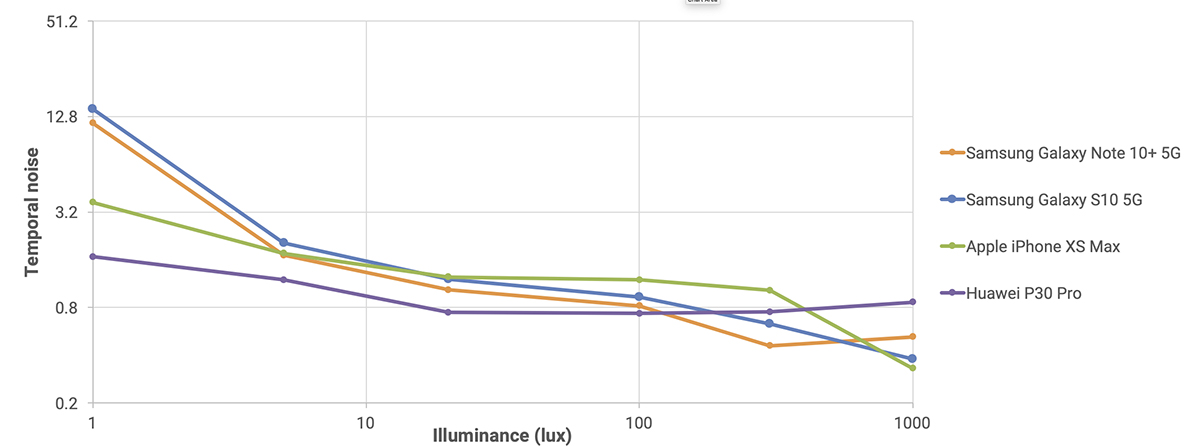
Samsung Milky way Note ten+ 5G, video temporal noise comparison
In terms of video artifacts, the Note ten+ behaves very similarly to the S10 5G, with some potent aliasing and tone compression resulting in heavier penalties in this category. The Note x+ 5G'south stabilization is very effective, even so, with residue motility and judders well-controlled in handheld walking and panning videos. The Note 10+ 5G's autofocus is also very competent when shooting video, and its fast response times and minimal refocusing mean that you can exist confident of shine video playback in virtually atmospheric condition.
Samsung Galaxy Note 10+ 5G, outdoor video walking
Samsung Galaxy S10+ 5G, outdoor video walking
Apple iPhone XS Max, outdoor video walking
Conclusion
With the connected improvement of camera performance for both mid-range models and cheaper flagship devices, there'south pressure on Samsung to proceed improving the prototype quality on its premium devices. Fortunately, the new Samsung Galaxy Note 10+ 5G does but that. Thanks to hardware advancements such as a new chipset and a wider aperture on the tele-photographic camera, improved algorithms and fine-tuning, the Note 10+ 5G has farther improved on the splendid performance of previous high-end Samsung devices, making it the meridian-ranked device for prototype quality in our database. It's a solid all-rounder, with fantabulous withal paradigm and video quality in almost lighting weather condition. The Notation 10+ 5G's combination of excellent exposure, colour, detail and bokeh for stills, together with excellent all round video, means that information technology steals the top-spot spoils from the Huawei P30 Pro for now.
Pros
- Fast, accurate and repeatable autofocus
- Accurate target exposures outdoors and indoors with broad dynamic range
- Pleasant bokeh with expert blur gradient and nice spotlights
- Well-controlled noise
- Vivid and pleasant color in nigh atmospheric condition
- Good detail in zoom shots at close and medium range
- High detail in flash shots
- Skilful detail in indoor and outdoor videos
- Well-managed racket in indoor and outdoor videos
- Generally good video exposure with wide dynamic range
- Brilliant and bright color in videos
- Fast, accurate and repeatable autofocus for video
- Effective video stabilization
Cons
- Ringing, aliasing, and loss of localized item
- Some oversaturated color and occasional white balance casts
- Occasional dissonance in dark areas in indoor and outdoor shots
- Some depth estimation failures in bokeh shots
- Fine detail lost in long-range zoom shots
- Pink color bandage in low light videos
- Fibroid noise in low calorie-free videos
- Loss of texture in low light videos
- Exposure instabilities with video autofocus tracking
Videos
In the Press
Source: https://www.dxomark.com/samsung-galaxy-note-10-5g-camera-review/
0 Response to "Galaxy Note 10 Plus Video Stabilization"
Post a Comment